
Wildlife Technologies Mighty Atom MA-21
MA21 Description | MA21 Features | Calling Wildlife | Transmitter Functions | Call List | Purchase
Designed and engineered in Germany. A state of the art no compromise wildlife caller.
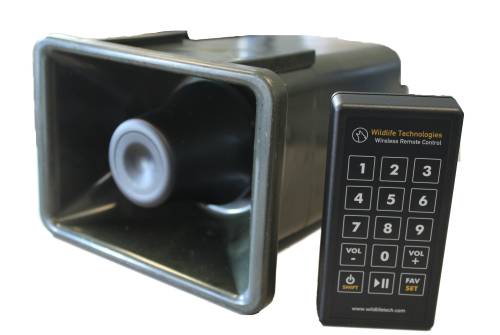
Wildlife Technologies - 126 Sound MA-21 with Wireless Remote Control $589.95
Back to Top | MA21 Features | Calling Wildlife | Transmitter Functions | Call List | Purchase
Thoughts about building and designing digital Wildlife callers from Wildlife Technologies... In order to design the ideal wildlife caller, we first had to define the requirements of wildlife calling. After 16 years of exhaustive research, we determined there were three basic considerations that must be met in order to build the ideal wildlife caller. First is the aural (hearing) sensitivity of the individual animals and their ability to discriminate between the subtle differences (details) of a given sound. We researched published research in this area and also conducted our own studies. We found that most animals can aurally differentiate or discriminate between the smallest details of a sound. The lesson learned from these studies is quite apparent. If you're not using high quality sounds (studio grade quality) when calling animals, your chances of success are diminished.
The second consideration was to integrate a state-of-the-art, solid-state digital audio system capable of reproducing each animal sound as accurately as possible. The sound system we use is controlled by software, just like a computer. This software control gives the product reliability and versatility that is unmatched in the wildlife caller industry.
The third consideration is volume. Thru our research we have also discovered that most animals, when listening to a sound, perceive the distance between their position and the sound source by the volume of the sound source. Extreme volume creates territorial aggression with most predators when using the sound of the species you are trying to call. Our wildlife caller is the only caller you can buy that is guaranteed to trigger responses (territorial howling) from coyotes 100% of the time at night providing they are in the calling area. Imagine being able to locate predators first and then call them. That's just one of the reasons why more professional wildlife callers choose our systems over our competitor's products.
The MA-21 with Wireless Remote Control WITH 126 sounds is a professional quality game caller and the most advanced to date in the family of Wildlife Technologies game callers. Wildlife Technologies callers are currently used by Disney, Motorola, Soundelux, Warner Brothers, USDA Federal Trappers, US Forest Service, US Geological Survey, Canadian Wildlife Service, Australia Zoological Agency, Australia Department of Parks and Wildlife, Zoo's in the US and abroad, UK DNR, landfills in the US and Canada along with many hunters, photographers, biologists, and nature watchers worldwide.
The Might Atom MA-21 Features Include:
MA21 Description | Back to Top | Calling Wildlife | Transmitter Functions | Call List | Purchase
- All-weather capability. Our systems are used from the Alaskan tundra to the plains of Africa.
- specifications:
- Power handling capacity- 100 watts.
- Frequency response- 300Hz - 10.5 Khz.
- Sensitivity:>130 db SPL @ 21 Volts.
- Digital Amplifier - loud clear audio and extends battery life by up to 50%.
- Audio of this quality is usually only found in professional equipment.
- 5" x 5" x 9 3/8.
- Total weight is approx. 5.3 pounds.
- The MA-21 produces ear shattering volume while maintaining crystal clear sound.
- The system uses 14 AA Batteries (not included).
- No moving parts.
- 126 calls come standard.
- The system can store 1000 different sounds simultaneously. Our sounds have been digitally recorded from wild animals and are studio grade quality.
- The user can stop play, play, pause, change volume or switch from one sound to another instantly.
- Whether you play a sound one time or one million times, the sound quality will always be CD quality.
- As of January 4th, 2012, MA21's feature the NEW 3rd Generation Internal Antenna (no external antenna)
- 2 year limited warranty.
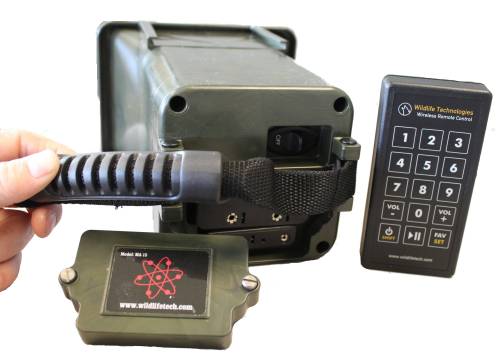
MA21 Pictured from rear with battery access panel removed and carry strap visible
Calling Wildlife
MA21 Description | MA21 Features | Back to Top | Transmitter Functions | Call List | Purchase
There are three fundamental rules you must follow if you want to consistently call wildlife:
- The recorded animal vocalizations must be almost identical to the animal's own sound (studio-grade recordings).
- The system playing the sounds must be capable of electronically reproducing those sounds as perfectly as possible. The system must also be capable of controlling the play functions stop, play, pause, volume and change sounds instantly.
- The wildlife calling system must be capable of producing extreme volume to create an illusion of presence which will trigger a territorial response from the predator and cause the predator to focus on the sound and not the caller. Copyright © 2002 Wildlife Technologies.
The Wildlife Technologies Remote Control (as of 12/2009)

Transmitter Functions
MA21 Description | MA21 Features | Calling Wildlife | Back to Top | Call List | Purchase
- Play.
- Pause.
- Stop play.
- Change sounds.
- Repeat function (loop).
- Instant pre-set volume levels.
- Optional remote control output for decoys etc.
- Choose and store favorite sounds (up to 10) in just 1 key.
- The user can change any of their favorite sounds anytime.
- The transmitter case is designed to be comfortable to hold.
- Excellent tactile feedback from the keys on the membrane pad.
- Easy to operate with gloves due to the large membrane keypad.
- Green LED to indicate true condition of battery power supply.
- Red LED to indicate that the transmitter is actually transmitting.
- Absolutely the best designed transmitter in this industry.
- Designed and engineered in Germany.
- Power supply: 2 X AAA batteries (alkaline or lithium).
- Battery life: Greater then 5 years.
126 Pre Programmed Calls Listing
MA21 Description | MA21 Features | Calling Wildlife | Transmitter Functions | Back to Top | Purchase
- 01 Vole Distress
- 02 Mouse Distress (Deer Mouse)
- 03 Muskrat
- 04 Mink Baby Distress
- 05 Skunk Adult Distress
- 06 Skunk Baby Distress
- 07 Barred Hare Distress
- 08 Cottontail Adult Distress
- 09 Cottontail Young Distress
- 10 Cottontail Baby Distress
- 11 European Hare Distress
- 12 Flemming Hare Adult Distress
- 13 Fleming Hare Baby Distress
- 14 Jack Rabbit Adult Distress
- 15 Jack Rabbit Young Distress
- 16 Pigmy Rabbit Distress
- 17 Snowshoe Hare Distress
- 18 Bobcat Adult Female Distress
- 19 Bobcat Baby Distress
- 20 Bobcat Young Call
- 21 Bobcat Adult Female Call
- 22 Bobcat Female In Heat Call
- 23 Lynx Adult Female Call
- 24 Lynx Baby Distress
- 25 Pine Martin Distress
- 26 Prairie Dog Distress
- 27 Red Squirrell Distress
- 28 Gray Squirell Distress
- 29 Gray Squirrell Growls
- 30 Fox Squirell Distress
- 31 Black Squirell Distress
- 32 Pig Adult Distress
- 33 Pig Baby Distress
- 34 Javelina Adult Distress
- 35 Javelina Young Distress
- 36 Raccoon Adult Distress
- 37 Raccoon Baby Distress
- 38 Raccoon Baby Call
- 39 Raccoon Young Growls
- 40 Raccoons Fighting
- 41 Porcupine Distress
- 42 Red Fox Adult Male Distress
- 43 Red Baby Distress
- 44 Red Fox Young Fighting
- 45 Red Fox Adult Female Mating Call
- 46 Red Fox Adult Male Mating Call
- 47 Red Fox Young Calls
- 48 Red Fox Young Begging
- 49 Gray Fox Adult Male Distress
- 50 Gray Fox Adult Female Distress
- 51 Gray Fox Young Distress
- 52 Gray Fox Bark
- 53 Gray Fox Fighting
- 54 Gray Fox Challenge Call
- 55 Groundhog Adult Distress
- 56 Groundhog Baby Distress
- 57 Redtail Hawk Screams
- 58 Pileated Woodpecker Distress
- 59 Ringneck Adult Female Distress
- 60 Ringneck Young Male Distress
- 61 Blackbird Distress
- 62 Blue Jay Distress
- 63 Bluebird Distress
- 64 Chicken Distress
- 65 Rooster Distress
- 66 Flicker Distress
- 67 Magpies
- 68 Ravens Fighting
- 69 Raven Baby Distress
- 70 Crow High Pitched Distress
- 71 Crow Low Pitched Distress
- 72 Crow Young Distress
- 73 Crow Baby Distress
- 74 Crow Young Communicative
- 75 Crow Alarm Calls
- 76 Crows Mobbing
- 77 Great Horned Owl
- 78 Barred Owl Call
- 79 Coyote Adult Female Howls
- 80 Coyote Young Female Howls
- 81 Coyote Young Female Territorial
- 82 Coyote Adult Female Mating
- 83 Coyote Adult Alpha Female
- 84 Coyote Young Howl
- 85 Coyote Adult Male Challenge
- 86 Coyote Adult Bark
- 87 Coyote Dominate Male Howls
- 88 Coyote Beta Male Howls
- 89 Coyote Male Territorial Howls
- 90 Coyote Young Male Aggressive
- 91 Coyote Adult Pair Aggressive
- 92 Coyote Adult Male Challenge Duet
- 93 Coyote Adult Male Rally Duet
- 94 Coyote Adult Male Communicative
- 95 Coyote Adult Submissive
- 96 Coyote 8 Months Old Distress
- 97 Coyote Adult Distress
- 98 Coyote Pup Submissive
- 99 Coyote Pup Whining
- 100 Coyote 3 Week Pup Distress
- 101 Coyote 10 Week Old Pup Distress
- 102 Coyote Fighting Over Food
- 103 Coyote Pups Howling
- 104 Coyote Young Group Howl
- 105 Coyote Adult Male & Female Howling
- 106 Coyote Hunting Whines
- 107 Coyote Adult Male Rally Group Howl
- 108 Moose Calf Distress
- 109 Antelope Fawn Distress
- 110 Mule Deer Fawn Distress
- 111 Elk Calf Distress
- 112 Whitetail Fawn Distress
- 113 Lamb Baby Distress
- 114 Goat Baby Distress
- 115 Cow Calf Distress
- 116 Wolf Young M&F Howling
- 117 Wolf Young Male Howls
- 118 Wolf Adult M&F Howling
- 119 Wolf Adult Male Howls
- 120 Wolf Pup Distress
- 121 Cougar Adult Female Call
- 122 Cougar Adult Male Calling
- 123 Cougar Young Call
- 124 Black Bear Submissive
- 125 Black Bear Baby Distress
- 126 Black Bear Adult Distress
MA21 Description | MA21 Features | Calling Wildlife | Transmitter Functions | Call List | Back to Top | Purchase